


If AI Doesn't Mention Your Brand, You Don't Exist
Branding in the age of answer engines: why being named in an AI answer is a positioning problem, not a search one.

Brand visibility in AI answers is a branding problem, not an SEO problem. Answer engines cite brands they can identify, verify and describe consistently and most of the signals they use come from outside your website. If your positioning, naming and claims differ across your site, your directory profiles and third-party coverage, you become expensive to cite, and the engine cites someone else.
Key takeaways
- Click-through on queries that show an AI summary has collapsed. Pew Research Center found users clicked a traditional result 8% of the time when an AI summary was present, against 15% when it was not.
- Being cited still pays without the click. A name a buyer reads inside an answer is a name they can search for later, which is why branded search belongs next to sessions in your reporting.
- Visibility is unstable. In AirOps' 2026 State of AI Search, only 30% of brands stayed visible from one answer to the next, and 20% survived five consecutive runs of the same query.
- Most of the evidence engines use is not yours. In the same study, 85% of brand mentions originated on third-party pages rather than the brand's own domain.
- Most brands are still operating here without a deliberate strategy. That gap is the opportunity.

The metric that used to matter has stopped working
For twenty years the question was where you ranked. The answer produced a click, and the click produced a session you could measure.
That chain is breaking in the middle. When a query returns an AI-generated summary, most users read the summary and stop. Pew's numbers put it plainly: clicks nearly halve when a summary is present. The ranking still exists. The traffic it used to produce does not.
What replaced it is harder to see and harder to game: whether the answer names you.
This matters more than it sounds. When someone asks ChatGPT for the best design agency for a B2B SaaS rebrand, the model returns three or four names and a sentence about each. Those sentences are the new first impression. You did not write them, you cannot edit them, and they are assembled from whatever the model can find and reconcile about you.
That is a brand problem. It has been misfiled as a search problem for two years.
Why this is branding work and not SEO work
Three reasons, and they compound.
First, the unit of visibility is the entity, not the page
Traditional SEO optimises a URL for a query. An answer engine is trying to determine what kind of company you are, what you do, who you serve, and whether the claims about you agree with each other. That is the definition of positioning.
Second, the evidence is mostly off-site
In the AirOps data, community platforms like Reddit and YouTube account for 48% of all citations, and the large majority of brand mentions come from pages the brand does not control. You cannot optimise your way to that. You earn it through published work, real reviews, directory presence, guest appearances, and being the kind of company people describe accurately when they mention you in passing.
Third, inconsistency is fatal in a way it never was for Google
Google could rank a page it did not fully understand. A language model assembling an answer has to reconcile conflicting descriptions, and the cheapest way to resolve a conflict is to use a different source. If your homepage says one thing, your LinkedIn says another, and your Clutch profile says a third, you are not merely diluted. You are a liability to the answer.

Brand consistency as data infrastructure
Here is the reframe that changes how a branding project should be scoped in 2026.
A brand guideline document has historically governed appearance: logo, palette, type, tone. What it now also has to govern is fact. What you are called. What category you belong to. Where you operate. What you charge. What you claim. What you refuse to do.
Those facts live in more places than most teams realise, and they drift:
- The homepage headline, which changes every rebrand
- The meta description, which was written by whoever built the page
- The LinkedIn company description, which nobody has read since 2022
- Directory profiles on Clutch, DesignRush, platform partner listings
- Structured data, if it exists at all
- The bio at the bottom of every article you publish
Every one of those is an input to how a model describes you. Treat them as one system with one source of truth, and audit them the way you would audit a codebase. Brand consistency stopped being an aesthetic virtue and became a data quality requirement.
What actually correlates with being cited
The honest framing first: no engine publishes its selection mechanism, and any checklist that claims certainty is selling something. What exists is correlational evidence and one solid piece of academic work.
The GEO study from Princeton, Georgia Tech, IIT Delhi and the Allen Institute, presented at ACM KDD 2024, tested nine optimisation methods across 10,000 queries. Three produced the largest consistent lifts in visibility within AI responses:
- Adding quotations — 40.9%
- Adding statistics — 32.1%
- Citing sources — 30.6%
Note what the same study found on the other side: keyword stuffing, the oldest lever in the SEO toolbox, actively hurt visibility.
Industry tracking data points the same direction on structure. Pages with sequential heading hierarchy and rich schema markup show materially higher citation rates, and pages left unrefreshed for a quarter or more are markedly more likely to lose citations they previously held.
Read together, five things are doing the work:
- Retrievable structure. A direct answer near the top, sequential headings, real text, schema markup describing what the page is.
- Verifiable specificity. Numbers, named sources, dates. Vague marketing prose cannot be quoted, so it is not.
- Attributable authorship. A named author with a real, checkable bio. Anonymous content is weak evidence.
- Off-site corroboration. Third-party pages that describe you the same way your own site does.
- Freshness. Content that is maintained, with a visible date.
Note what is absent from that list: keyword density, backlink volume as a primary lever, and domain age. The relationship between domain authority and citation frequency is real but far from deterministic. A small studio with genuine expertise and disciplined structure can be cited alongside firms twenty times its size. That has not been true in organic search for a decade.
.webp)
A 90-day plan that does not require new tooling
Days 1–30: Establish the facts
Write a one-page entity sheet: legal name, trading name, category in plain language, locations, services, price bands, three claims you can defend. Then reconcile every public surface against it. Site copy, metadata, structured data, LinkedIn, Instagram, every directory. This is unglamorous and it is the highest-leverage work on the list.
Days 31–60: Make the site extractable
Add Organization schema sitewide and Article schema to every post. Give each key page a direct 40–60 word answer near the top. Fix heading hierarchy. Add visible author bios with real credentials. Publish at least one page containing specific, quotable numbers; pricing, timelines, measured results.
Days 61–90: Earn the off-site evidence
Claim and complete directory profiles. Publish detailed case studies with real figures. Answer questions in the communities where your buyers actually are, under a real name, without pitching. This is the slowest part and the one competitors cannot copy.
How to measure it without buying a platform
Tracking tools exist and several are good. You do not need one to start.
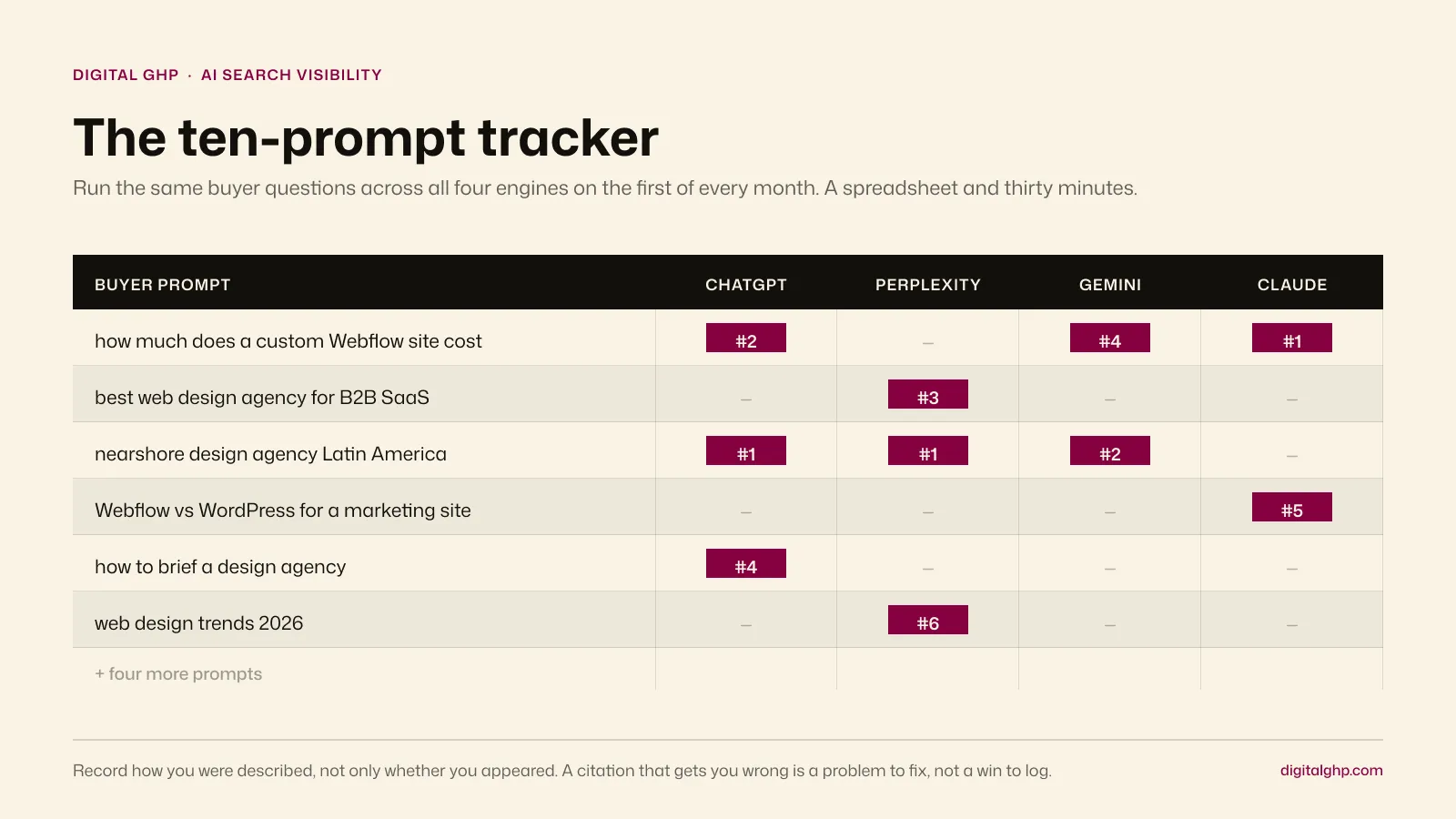
Write ten prompts a real buyer would type. Not keywords, full questions, because people type conversationally to an assistant in a way they never did into a search box. Something like "best web design agency for a B2B SaaS rebrand" or "how much should I budget for a custom Webflow site."
Run all ten in ChatGPT, Perplexity, Gemini and Claude on the first of each month. Record four columns: are you mentioned, in what position, with what description, linking to which URL.
Two disciplines make this useful rather than decorative. Run each engine separately. They do not behave alike, in the AirOps data, Perplexity referenced community platforms in over 90% of its answers while Gemini did so in as few as 7%. An average across engines hides exactly the thing you need to see. And record the description, not just the mention, a citation that misdescribes what you do is a problem to fix, not a win to log.
That is a spreadsheet and half an hour a month. It produces a real time series instead of an intuition.
The uncomfortable part
This work has a lag. Entity consistency, off-site corroboration and content freshness compound over quarters, not weeks. Anyone promising AI visibility in thirty days is describing a coincidence.
It also has an unfamiliar failure mode: you can do everything correctly and still be described inaccurately, because you do not control the output. The only defence is to make the accurate description the easiest one to assemble.
The upside is that this is genuinely early. With most brands operating without any deliberate strategy here, the bar for being the most legible company in your category is lower now than it will ever be again.
If you want a second pair of eyes on how your brand currently reads to a machine, tell us what you are building.
FAQ
What is answer engine optimisation?
Structuring content and brand information so AI systems can extract, cite and accurately summarise it. It overlaps with SEO but optimises for being quoted rather than for being clicked.
Is AEO different from SEO?
They share technical foundations; crawlability, structure, schema. They diverge on the goal. SEO competes for a position in a list of links. AEO competes to be the source an answer is built from, which depends heavily on off-site corroboration and consistency.
Does my brand need to be big to get cited?
No. Domain authority correlates with citation but does not determine it. Specific, well-structured, clearly authored content from a small brand is regularly cited alongside far larger competitors.
How do I know if AI mentions my brand?
Run ten buyer-intent prompts across ChatGPT, Perplexity, Gemini and Claude monthly and log whether you appear, how you are described, and which URL is linked. Dedicated tracking platforms exist, but a spreadsheet is enough to start.
Does traffic still matter if nobody clicks?
Yes, but it is no longer the only outcome worth measuring. A citation that produces no click still produces branded search later. Track branded search volume alongside sessions.
Sources
- Pew Research Center, Google users are less likely to click on links when an AI summary appears in the results, July 2025.
- AirOps, The 2026 State of AI Search.
- Aggarwal, Murahari et al., GEO: Generative Engine Optimization, ACM KDD 2024.


